A motorway breakdown gives you very little time to think. Traffic is moving at 70mph, the hard shoulder is narrow, and on a smart motorway there may be no hard shoulder at all.
The sequence below is the one recovery operators and Highways England guidance both recommend. Read it now, and it will be automatic when you need it.
1. Get off the carriageway if you safely can
The moment you feel a problem — a warning light, a loss of power, a vibration — take the next exit or services if the vehicle will make it. A controlled stop somewhere safe is always better than an emergency stop in a live lane.
If you cannot leave the motorway, move as far left as possible onto the hard shoulder, park as close to the verge as you can, and turn your wheels to the left so the car does not roll back into traffic.
2. Make yourself visible immediately
- Switch on hazard warning lights the second you slow down.
- Use sidelights in poor visibility, fog or after dark.
- Put on a hi-vis vest before you get out — keep one in the door pocket, not the boot.
- Never use a warning triangle on a motorway. It puts you in a live lane.
3. Leave the vehicle by the left-hand doors
Everyone gets out of the nearside doors, climbs over the barrier, and waits on the embankment behind the barrier — not in the car, not in front of it, and not on the hard shoulder itself.
Animals stay in the vehicle unless there is an immediate danger. Keep a lead attached if you do have to move one.
4. Smart motorways: no hard shoulder, different rules
On an all-lane-running smart motorway the former hard shoulder is a live lane. Aim for the next Emergency Refuge Area (ERA) — the orange bays marked with an SOS sign, usually spaced up to 1.5 miles apart.
If you cannot reach one and you are stopped in a live lane, keep your seatbelt on, keep hazards on, and call 999 straight away. Only leave the vehicle if it is clearly safe to do so on the nearside. National Highways can close the lane above you with a red X before recovery arrives.
5. Call for recovery with the right information
Use the orange SOS phone if there is one nearby — it pinpoints your location automatically. Otherwise use the driver location marker signs on the verge, which give the road number, direction and distance in kilometres.
- Road number and direction of travel, e.g. M69 northbound.
- The nearest junction number or driver location marker.
- Vehicle make, model, colour and registration.
- Whether the vehicle is drivable, has a flat tyre, or will not roll.
- Number of passengers, and any children or vulnerable passengers.
6. Rejoining or being recovered
If the fault is fixed at the roadside, build up speed on the hard shoulder before merging, and wait for a genuine gap — do not force your way in.
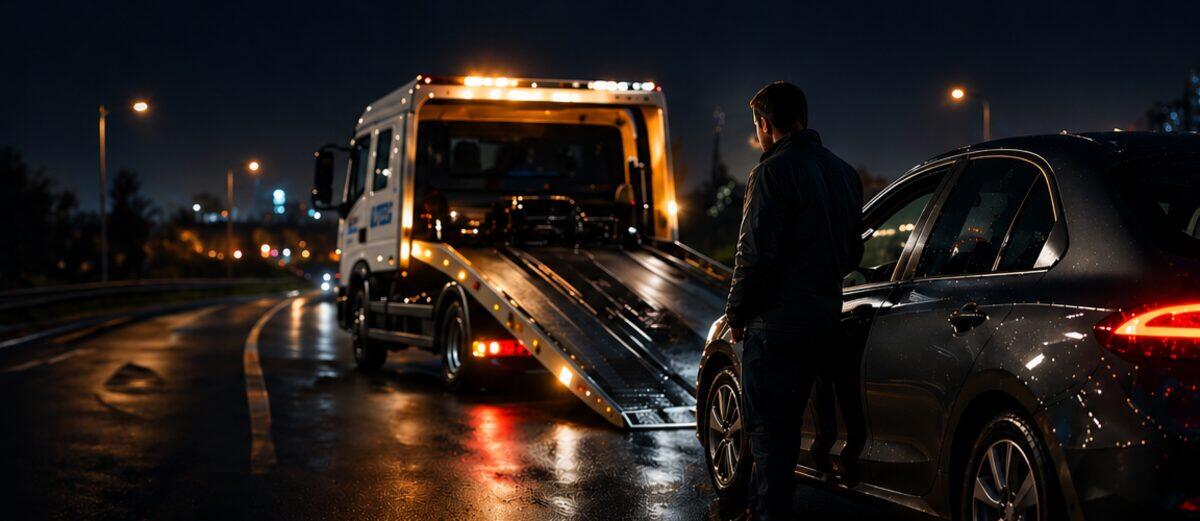
If the vehicle needs recovering, the operator will load it onto a flatbed or use a spec lift. Tell them the destination in advance: home, a garage, a bodyshop or a storage yard. A single planned journey is always cheaper than two separate ones.